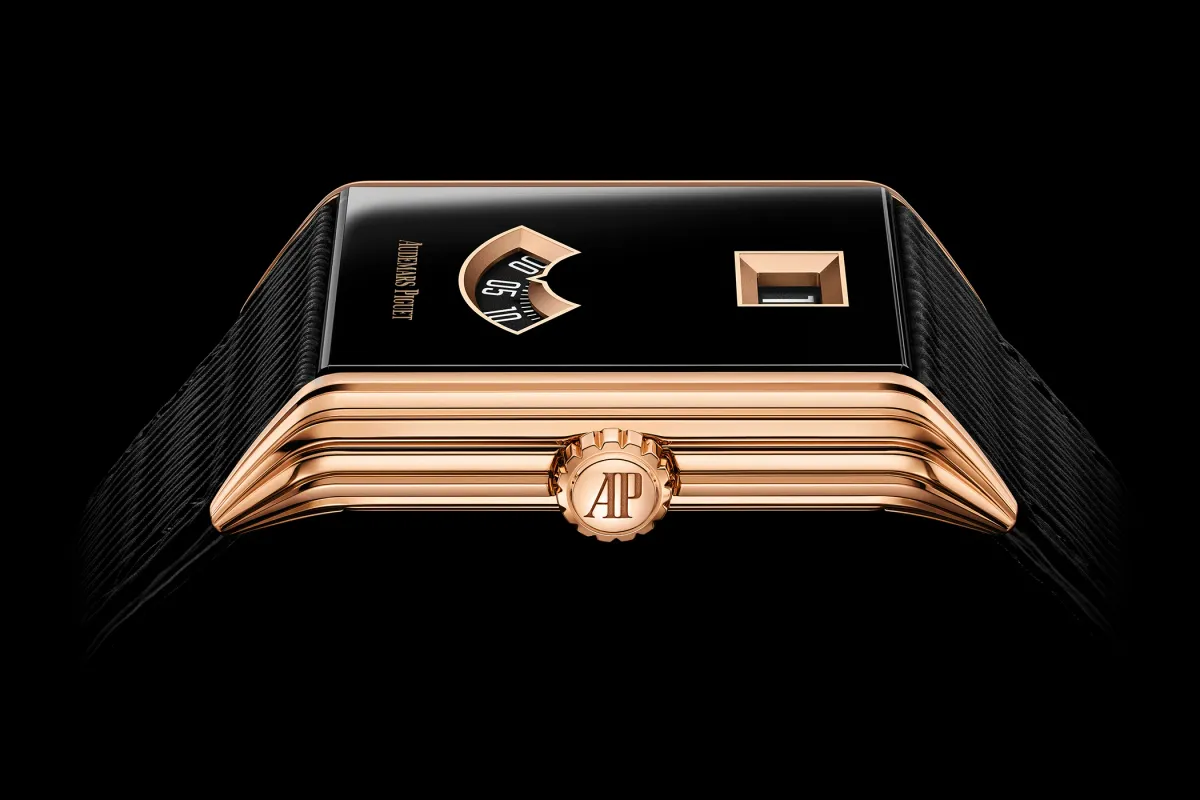
Wait, That’s an AP?
No, that’s not a Cartier Tank à Guichets. It’s Audemars Piguet’s Neo-Frame Jumping Hour, and it appeared alongside a heavy run of 2026 releases that quickly filled feeds for anyone even loosely paying attention to watches.
Most of those early-year AP drops look exactly how people expect them to. Royal Oaks in yellow gold with malachite dials, sized at 37mm and 41mm. A Royal Oak Mini leaning further into jewelry-watch territory with black onyx and extra-white mother-of-pearl.

Offshore Divers and chronographs experimenting with ceramic, titanium, and color. These are watches that slot easily into the lives of people who already wear an AP without much deliberation.
The Royal Oak still does most of the talking. It’s one of the most successful pieces of industrial design watchmaking has ever produced, and Gérald Genta’s original idea still carries weight every time that octagonal bezel shows up on a wrist.


When someone says they’re wearing an AP, that silhouette is usually what comes to mind first. The Code 11.59, the [RE]Master pieces, even the brand’s more experimental work tend to sit just outside that immediate association.
The Neo-Frame Jumping Hour arrives without asking to be read through the Royal Oak first.
Instead, it pulls from a quieter part of Audemars Piguet’s history, referencing rectangular jumping-hour pieces from the late 1920s and early 1930s, including a platinum model now housed in the brand’s Musée Atelier.

These were watches made long before the Royal Oak reshaped AP’s image, from a period when the brand was experimenting with how time could be displayed through form rather than framed by a bezel.
The watch looks archival at a glance, but it doesn’t stay there. The 18-carat pink-gold case measures 47.1mm long, 34mm wide, and just 8.8mm thick. On paper, that footprint sounds assertive, but on the wrist the proportions settle quickly. Eight vertical gadroons run down each side of the case, stretching into long, tapering lines that resolve into pointed lugs. It feels architectural without becoming stiff, decorative without drifting into costume.
There isn’t a traditional dial. The Neo-Frame uses a black PVD-treated sapphire crystal bonded directly to the dial plate, with time shown through two apertures for the jumping hour and trailing minutes.
With no metal framing at twelve and six, the entire assembly is screwed directly into the case, giving the watch 20 meters of water resistance and a level of durability that vintage guichet watches were never designed around.
Inside sits Calibre 7122, Audemars Piguet’s first self-winding jumping-hour movement. It shares its underlying architecture with the Royal Oak “Jumbo,” but it’s been adapted for a complication that depends on precision.

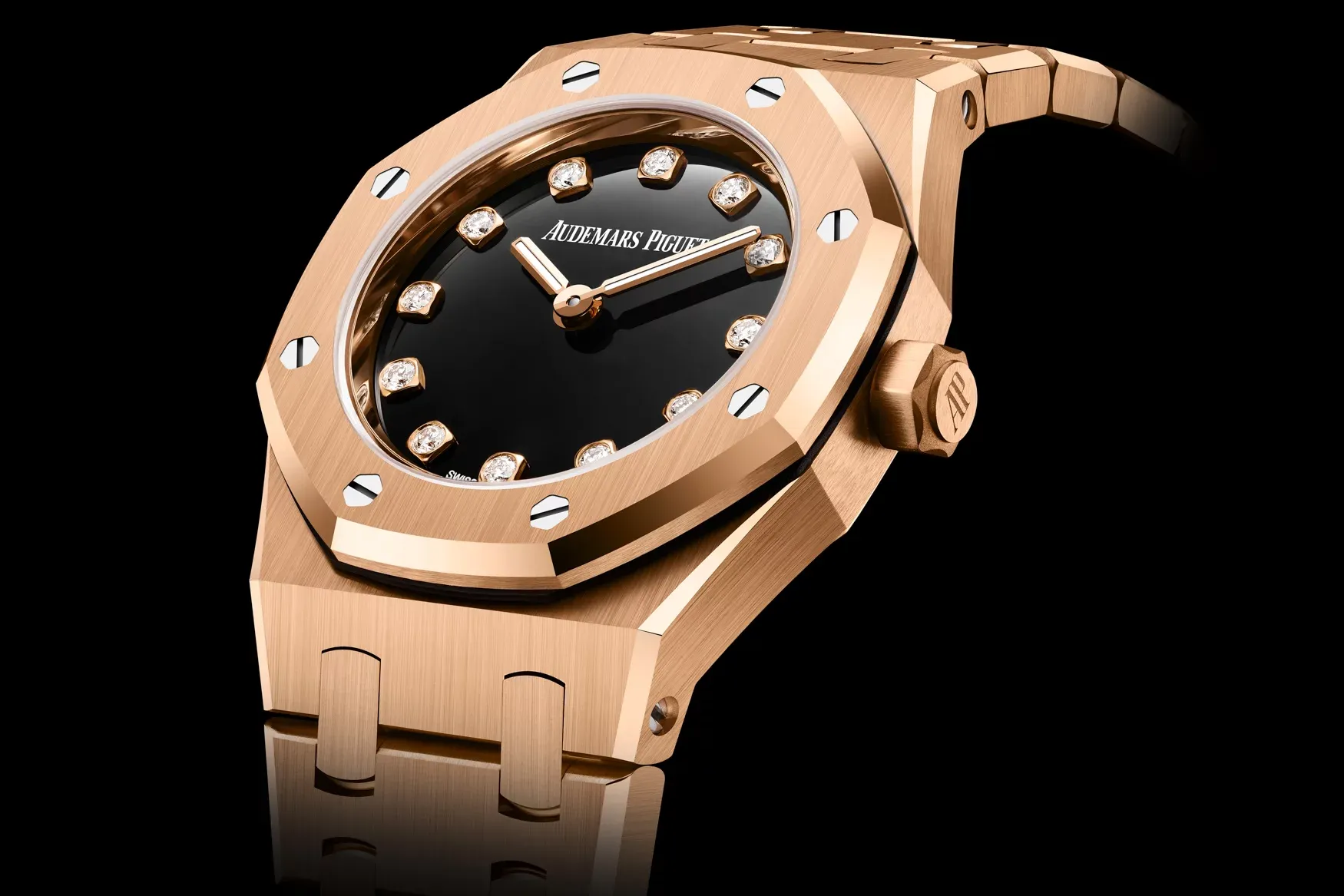
A patented shock-absorbing system helps prevent accidental hour jumps, paired with a titanium hour disc and an aluminium minute disc. Power reserve lands at 52 hours with a 4 Hz frequency. It feels built for regular wear, not careful handling.
Placed next to the rest of the 2026 lineup, the contrast is easy to spot. Skeletonized Royal Oaks in titanium with Bulk Metallic Glass bezels strip familiar forms down to their structural core.
Openworked perpetual calendars with crown-only correction systems continue AP’s push toward complications that fit into daily routines. Malachite dials and deep “Bleu Nuit, Nuage 50” ceramic cases lean into material and color without asking for much explanation.

The Neo-Frame Jumping Hour sits slightly apart from all of that. It doesn’t announce itself, and it doesn’t lean on the Royal Oak to be understood. It’s the kind of watch that gets mistaken at first, then noticed, then reconsidered once the conversation catches up.
And then it just stays there.